# Tokenomics

### <mark style="color:blue;">Token Flow</mark>

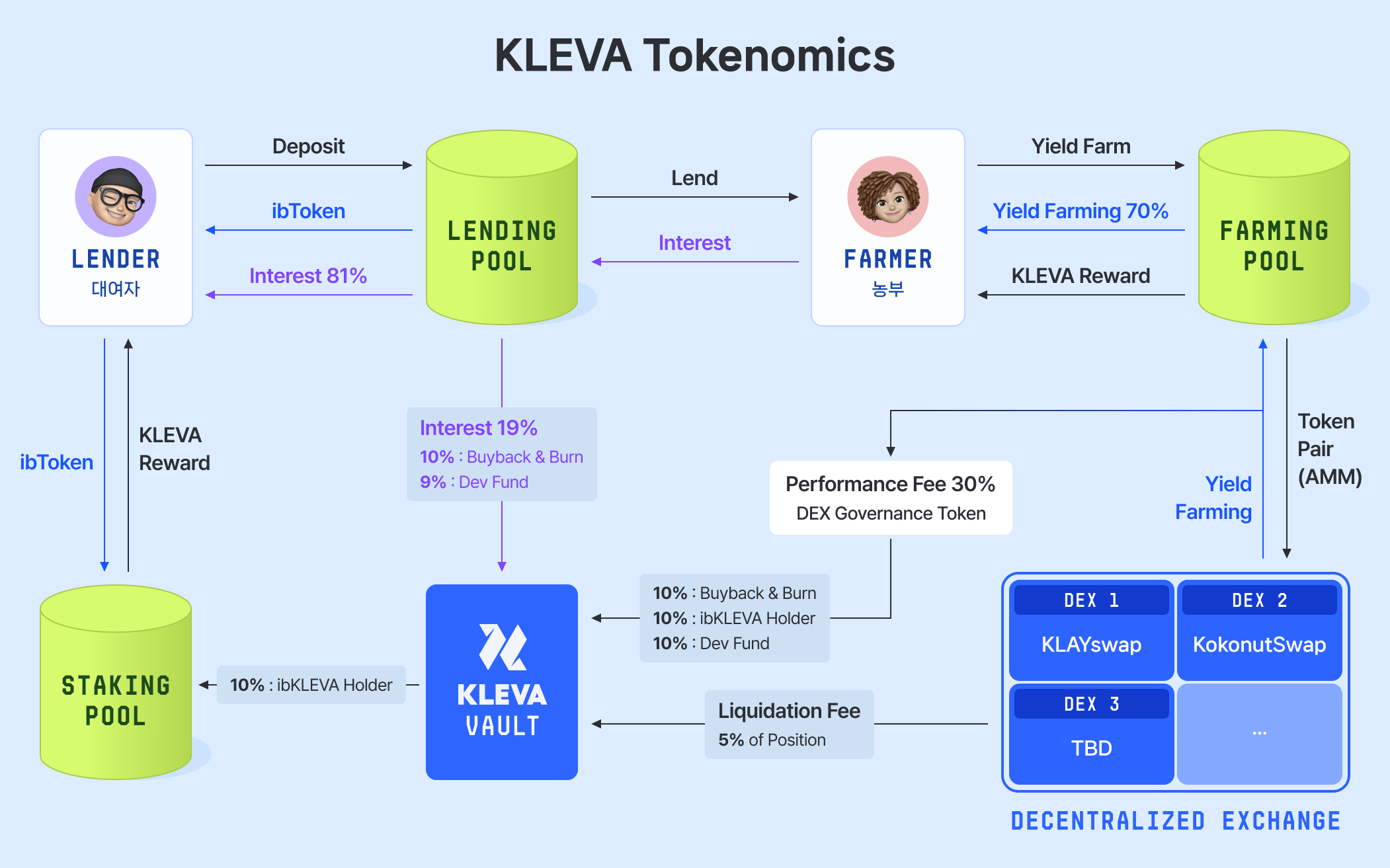
<figure><img src="/files/bK9c9AExA4acKnuVIR36" alt=""><figcaption></figcaption></figure>

### <mark style="color:blue;">Distribution</mark>

<table><thead><tr><th width="197">Category</th><th width="79">%</th><th width="172">To</th><th width="353">Details</th></tr></thead><tbody><tr><td>KLEVA Mint</td><td>75%</td><td>Users</td><td>Depositor(Staker) Profit, Lender Reward</td></tr><tr><td></td><td>15%</td><td>Dev Fund</td><td>Protocol Operation</td></tr><tr><td></td><td>10%</td><td>Eco Fund</td><td>KLEVA Ecosystem Expansion</td></tr><tr><td>Lending Fee</td><td>81%</td><td>Users</td><td>Depositor Profit</td></tr><tr><td></td><td>9%</td><td>Dev Fund</td><td>Protocol Operation</td></tr><tr><td></td><td>10%</td><td>Buyback &#x26; Burn</td><td>Usage for Buyback &#x26; Burn</td></tr><tr><td>Performance Fee</td><td>70%</td><td>Users</td><td>Leverage Investor Profit</td></tr><tr><td></td><td>10%</td><td>Users</td><td>KLEVA Staking Reward</td></tr><tr><td></td><td>10%</td><td>Dev Fund</td><td>Protocol Operation</td></tr><tr><td></td><td>10%</td><td>Buyback &#x26; Burn</td><td>Usage for Buyback &#x26; Burn</td></tr><tr><td>Liquidation Fee</td><td>100%</td><td>Buyback &#x26; Burn</td><td>Usage for Buyback &#x26; Burn(5% of Liquidation)</td></tr><tr><td>Liquidator Reward</td><td>100%</td><td>Dev Fund</td><td>Protocol Operation(2% of Liquidation)</td></tr></tbody></table>

<mark style="color:blue;">Protocol Fee and Distribution</mark>

KLEVA's fee revenue is all related to leverage investments as followed:

* Interest fees on borrowing: 19% of the total interest.
* Auto-compound performance fees: 30% of the profits from leverage investment

Fee revenue is not fixed and it depends on the size of leverage investments, however, minimum 50% of total protocol fee is allocated as follows:

* 52.6% of the fee revenue from interest earned by borrowers: KLEVA token Buyback & Burn.
* 33.3% of the fee revenue from leverage investment DEX rewards auto-compound: KLEVA token Buyback & Burn.
* 33.3% of the fee revenue from leverage investment DEX rewards auto-compound: Additional rewards for KLEVA token staking

The remaining 47.4% of the fee revenue from interest earned by borrowers and 33.3% of the fee revenue from leverage investment DEX rewards auto-compound are utilized for protocol maintenance costs.

### <mark style="color:blue;">Interest Income (Depositor's Earnings)</mark>

* Leverage investors borrow assets from KLEVA, and pay interest costs.
* The interest costs paid by the borrowing user are accrued at position closure.
* 81% of the interest costs paid by the borrowing user, excluding a 19% fee, are distributed to depositors as interest income. This means that the interest costs paid by the investor borrowing KLAY become earnings for KLAY depositors.

### <mark style="color:blue;">Investment Profits (Leverage investors's Earning)</mark>

* Profits for leverage investors include distribution earnings from governance tokens provided by the target DEX and trading fee earnings (DEX's profit depends on the policies of the specific DEX).
* 70% of profit from governance tokens, excluding 30% as a fee, is automatically reinvested through the Auto-Compounding system.
* KLEVA token rewards are provided as compensation for lending assets. Since the KLEVA token is a reward for lending assets, it will not be provided without lending, meaning at a leverage ratio of 1.0
* The interest rate for borrowing varies based on the utilization rate of the respective pool. (Check the interest rate variation model.)
* The total earnings for leverage investments are calculated, including KLEVA token rewards.


---

# Agent Instructions: Querying This Documentation

If you need additional information that is not directly available in this page, you can query the documentation dynamically by asking a question.

Perform an HTTP GET request on the current page URL with the `ask` query parameter:

```
GET https://docs.kleva.io/legacy-en/overview/tokenomics.md?ask=<question>
```

The question should be specific, self-contained, and written in natural language.
The response will contain a direct answer to the question and relevant excerpts and sources from the documentation.

Use this mechanism when the answer is not explicitly present in the current page, you need clarification or additional context, or you want to retrieve related documentation sections.